Showing posts with label Miscellaneous. Show all posts

Thursday, 14 January 2021

Alternative Fuels for Diesel Engines

1. Biodiesel:

Biodiesel is fatty acid esters which are created through cracking of vegetable oils or greases and then converted with methanol or ethanol. If mixed with methanol, it creates fatty acid methyl ester (FAME) and if mixed with ethanol, it creates fatty acid ethyl ester (FAEE). The molecules of biodiesel are similar to diesel fuel in terms of size and properties.

Production of Biodiesel:

Biodiesel are produced from vegetable oils or animal fats. Europe primarily uses rape oil. Soybean oil and palm oil can also be used to produce biodiesel. Esterification of oil is carried out with either methanol or ethanol. Since methanol helps in simpler esterification, it is preferred more over ethanol. Therefore fatty acid methyl ester (FAME) is primarily used worldwide as an alternative biodiesel.

Since methanol is produced from coal, FAME is strictly not fully biogenous. FAEE on the other hand is made up of 100% biomass. The properties of biodiesel are determined by many factors. Different vegetable oils have different composition of fatty acid blocks. The type and quantity of unsaturated fatty acid blocks have decisive influence on the stability of biodiesel. The quality also depends on the pre-treatment of vegetable oils and the production process of biodiesel.

The quality of biodiesel varies from the regular diesel fuel, since biodiesel consists of fatty acid esters which are polar and chemically reactive. Diesel fuel on the other hand is an inert and nonpolar mixture of paraffins and aromatic compounds. 

Use of Biodiesel in vehicles:

Pure biodiesel (B 100) is used especially in Germany in commercial vehicles. The higher mileage ensures fast consumption, which ensures problems with insufficient oxidation stability to be avoided. It is more favourable to use biodiesel in a blend with conventional diesel fuel. The trend is towards small mixtures of 93% diesel and 7% biodiesel (B 7).

The presence of biodiesel in diesel fuel provides lubrication and hence additional lubricative additives are not required. In the case of higher biodiesel content in the diesel-biodiesel mixture (above B 30), the higher boiling point of fuel can cause it to escape to the engine oil via condensation on the cylinder walls. 

2. Rape Oils:

Rape oil can be used in older engines, especially those fitted with inline pumps. It is an inexpensive fuel, but increases emissions and also risks of engine failures.

Limitations:

Rape oil has high density and viscosity and is highly volatile in nature compared to diesel fuel. Direct usage of rape oil affects fuel supply at low temperatures due to the formation of residues on injector nozzles by thermal coking. 

3. Bioparaffins:

Bioparaffins are produced from fats and oils by means of hydrogentaion. Hydrogenation with hydrogen results in cracking of fats and oils, during which the oxygen atoms and other unsaturated bonds are removed. Long chain alkanes are created from fatty acids, while the glycerin is converted into propane gas. The end result is hydrocarbon molecules with better properties for combustion than biodiesel.

The product properties of bioparaffins are far greater than biodiesel. It is also more cost effective than biodiesel to produce bioparaffins because hydrogenation process can take place in petroleum refineries.

4. Synthetic Fuels:

Synthetic fuels are produced from individual chemical blocks. Coal, natural gas or biomass can be thermally converted into synthetic gas made up of carbon monoxide (CO) and hydrogen. Linear, straight chain hydrocarbons, n-paraffins are then produced from CO and hydrogen on Fischer-Tropsch catalysts. Further, isomerization can improve the quality of synthetic fuel, particularly its low temperature resistance.

Synthetic fuels are also called second generation fuels as its production process differs from the common hydrogenation or esterification process on oils and fats.

Fischer-Tropsch synthesis can produce a wide variety of other components such as short chain gasoline, kerosene, diesel paraffins, waxes. The composition of synthetic diesel fuels can be varied on the demands of the diesel engine with the help of catalysts of our choice.

The synthetic fuels produced by Fischer-Tropsch synthesis are purely aromatic and sulphur free. They also have a high cetane number. The density of synthetic fuel is lesser than the conventional diesel fuel at 800 kg/㎥.

Due to its lower HC, nitrogen oxide and CO emissions, it is above all other fuels available in the market.

5. Dimethyl Ether:

Dimethyl ether is a combustible and explosive gas produced from methanol. The boiling point of dimethyl ether is -25℃ at 1 bar. It has a cetane number of roughly 55 and on burning in engine produces low soot and nitrogen oxide emissions. 

Dimethyl ether has low density and high oxygen content, leading to a low calorific value. We would also need a modified and complicated low pressure fuel injection system to inject the gas. We also need a pressure proof fuel tank.




Wednesday, 13 May 2020

Car Heating System

In addition to air conditioning which is used to cool the cabin air in a vehicle, most modern day vehicles are also equipped with a heating system to warm up the cabin during winters. The heating system uses the heat of the engine to warm up the cabin air. There is a heater core which acts as a heat exchanger and is built inside the vehicle HVAC (heating, ventilation, air conditioning). 

The heater core in itself is a small radiator which is connected to the engine cooling system. A liquid coolant is used in the engine cooling system which is circulated through the engine and main radiator through a pump. The purpose of coolant is to absorb excess heat from the engine. The heated coolant travels through the radiator where ambient air flow absorbs the heat from the coolant. This cycle repeats. 

When a car's heating system is activated, the super hot coolant is made to run through the heater core. A blower motor/fan blows air on the heater core which absorbs the heat from the coolant. As a result, the air gets warm and this air is circulated inside the cabin through vents. 


Depending on the amount of heat required in the cabin, occupants can choose how much warm air is required. A heater control valve is used in the heater core to vary the flow of hot coolant. But most of the HVAC system use a temperature blend door to control the amount of hot air that has to flow through the vents. The working of temperature blend door is simple. The more the door is open, the more amount of air passes through the heater core and hence the air is warmer.

If the cabin air is not warming enough according to the requirement, then the amount of coolant needs to be checked in overflow bottle and if it is low then it should be topped up. If the heating system does not work efficiently, then it means there is some problem in the engine cooling system and it can damage the engine. 


Tuesday, 12 May 2020

How does Car AC work?

Air conditioning (AC) in cars used to be a luxury during the 1960s, but it has become a necessity in modern day cars. A vehicle's air conditioner doesn't actually cool the air. It just removes the heat and moisture out of the air present within the vehicle. The car AC works on two cycles: refrigeration and evaporative cooling.

Car AC works on the same principle as the home/office ACs. It has five main components:
  1. Compressor
  2. Condenser
  3. Receiver dryer
  4. Expansion valve
  5. Evaporator coil
The freon/refrigerant is used in AC system. The refrigerant is circulated through the entire system in closed circuit.


Compressor:

As the name suggests, compressor is used to compress the refrigerant to high pressure and temperature. In home ACs, compressor is run through electric motor. In cars, the compressor is driven by a belt connected to the engine crankshaft. A magnetic clutch is used to engage/disengage the compressor to the belt. Once compressed, the gaseous refrigerant is pushed out through discharge valve to the condenser.  


Condenser:


Condenser acts as a radiator to remove the heat from the refrigerant. Condenser sits in front of the car, just behind the front grille and in front of the car radiator. Ambient air passes through the condenser and removes the heat from the refrigerant. The high pressure gaseous refrigerant is converted into high pressure liquefied refrigerant.

Receiver Dryer:


The purpose of dryer is to remove the impurities and moisture from the liquefied refrigerant. It can also be used as a temporary storage tank for liquefied refrigerant.

Expansion Valve:


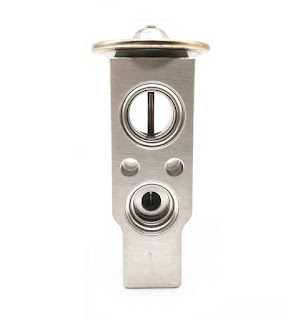
Expansion valve is used to control the amount of refrigerant entering the evaporator. It has a small hole which lets the valve to spray the refrigerant. As the high pressure refrigerant passes into the expansion valve, both pressure and temperature drop and it is sprayed into the evaporator in a misty form.

Evaporator:


Evaporator acts like a radiator. The low pressure, low temperature refrigerant in gaseous form passes through the coils inside the evaporator. A blower fan pulls the heat out from inside the vehicle cabin and blows the warm air over the evaporator. Since the temperature inside the evaporator is lower, it absorbs the heat from the blower and leaves behind cooler air. This cooled air is circulated into the car cabin. The refrigerant which is hot now and in gaseous form is circulated back to the compressor and the cycle keeps repeating.

Blower


Refrigerant:

Freon-R12 was used commonly but due to its damaging effects on the ozone layer, manufacturers have replaced it with R-134a. 


Wednesday, 15 February 2017

How does Nitro Boost (Nitrous oxide) work?

Many of us would have come across the term Nitro boost or ‘NOS’ in race cars and bikes. With the push of a button, we get a sudden surge in power and torque which helps us to overtake our opponents. The question is, how this nitro boost works and what enables the engine to produce a surge in power?

This article is to throw some light on the working of Nitrous Oxide and the working of it. Before that, we have to understand what causes an internal combustion engine to produce power. The power produced is the result of chemical reaction between air and fuel. Air contains nitrogen (approx. 78%) and oxygen (approx. 21%) and some other gases. Nitrogen gas in non-combustible and doesn’t take part in the chemical reaction. We have only oxygen left to help with the combustion. Hence, we can conclude that oxygen is required to burn fuel.


If we can increase the amount of oxygen intake to the engine, the amount of fuel intake can also be increased, and as a result we can increase the power output of the engine. The whole idea of nitrous oxide is to provide the engine with excess oxygen in order to increase the power output from the engine.

A nitrous oxide tank consists of ammonia nitrate, nitrous oxide and other varieties of nitrogen gas stored in liquid state, but it becomes gas when exposed to atmospheric conditions. As a result of vaporization, nitrous oxide significantly reduces the intake air temperature. Cold air has more oxygen density and increases the overall volumetric efficiency of a cylinder. With oxygen content increased, we can also supply more fuel to burn and produce excess power.

Types of Nitrous System:

·         Wet Nitrous System: In this system, nitrous oxide is mixed with fuel and sprayed in the intake manifold. This makes the inside of the walls of the manifold wet. A special type of nozzle is used to meter the fuel and nitrous in required amounts and then inject it in the manifold. The air-fuel mixture formed should result in proper atomization to gain more power. This system is more efficient than the dry type.

·         Dry Nitrous System: In this system, only nitrous oxide is injected in the intake manifold. Fuel is injected through a separate fuel injector. Nitrous oxide vaporizes resulting in cooling of air. The increase in the density of oxygen can be detected by mass air flow (MAF) sensor, and the ECU after receiving the signals can direct the electronic fuel injector to increase the timing it remains open to inject fuel. The additional fuel introduced can burn with the excess oxygen to provide additional power.

Do flames come out of the exhaust when we use Nitro?


This is also a common question inspired by the video games and movies. But the answer is no. Flames cannot come out of the exhaust pipes with the application of nitro.


Monday, 29 August 2016

Engine Muffler

Why do Engines make noise?


You would have seen lots of vehicles on road that make different noises. An engine makes a lot of pulsating noise as the exhaust gas escapes the exhaust valves at a very high pressure. These sounds bounce around the inner walls of the tail pipe and can create a loud and annoying noise. A muffler is used to minimize the sound and also tune the sound before the exhaust exits the tail pipe.

Where is a Muffler installed?

Mufflers are installed usually at the end of tail pipe. You can actually spot it as a big box and it does not treat the pollutants in the exhaust gases. It acts as an acoustic soundproofing device designed to reduce the loudness of the engine noise.


How does a Muffler work?

Mufflers are lined with baffles. As the exhaust enters the muffler, the sound waves bounce off these baffles, thereby creating opposing sound waves that cancel each other out. The baffles and chambers can also be tuned to get the desired sonic effect. We can either cut the sound as much as possible or focus on the desired sound with amplified growl range.

Can a Muffler affect engine performance?


Yes, a muffler can affect engine performance. The engine requires fresh charge as soon as the exhaust escapes the exhaust valves. The faster we can get rid of the exhaust from the exhaust pipe, the faster we can supply fresh charge to the engine and can improve its performance. Installation of muffler shouldn’t affect the flow rate of the exhaust from the system.

Wednesday, 25 May 2016

Air Filter

Air filter is a device that is used to remove airborne contaminants such as dust, pollen, etc. We all are aware that we should change our car’s air filter regularly.

Why is it necessary to have air filter?

The air must be cleaned before it is sent to the combustion chamber. If not, we run the risk of sending dust and debris that will affect engine performance. If the debris has any sharp and abrasive material, it will wear the engine parts such as piston and cylinder.

Types of air filter:

There are various types of air filters that offer different life expectancy.

·         Paper Filter: They are the most cost effective air filter. They are also efficient and easy to service. They have to be replaced every 5000 to 8000 miles.


·         Gauze Filter: The biggest benefit of gauze filter is that they can last the entire life of the vehicle. However, they need regular cleaning with the proper air filter cleaning kit. Cotton is usually used as the gauze material. There are 2 types: oil based and dry gauze air filter. Oil based filters are more effective in filtration but will require oil, whereas dry gauze filters will not be that effective in filtration. Overall gauze filters provide a better air flow than the paper filters.


·         Foam Filter: Polyurethane foam material is used in foam filters. The foam filters can last the entire life, provided it is cleaned regularly. Just like the oil based gauze filter, foam filter requires oil. They offer minimal air flow restriction and also high dirt capacity. The high dirt capacity makes it a popular choice in off road vehicles.


·         Stainless Steel Mesh: This type allows a better air flow. Stainless steel filters provided by Hurricane is one of the best in the market. It has uniform microscopic holes to ensure consistent filtration and air flow. The main advantage of stainless steel filters is that no oiling is required and it can be cleaned by simply washing it in water.